Why Your Dry January Failed Last Year (And How to Not Repeat It)

Let's talk about what actually happened last January.
You started strong. You were motivated. You told people you were doing it. You maybe even got through the first week. And then... you didn't make it. Maybe it was day 10. Maybe day 15. Maybe you technically made it to February 1st but immediately went back to drinking exactly like before, which kind of makes the whole thing pointless.
And here's the worst part: you blamed yourself. You decided you didn't have enough willpower, enough discipline, enough... something. You told yourself you'd try again this year and really commit this time.
But here's what nobody's telling you: it wasn't a willpower problem. It was a tools problem.
You failed last year because you were trying to build a house with your bare hands. No hammer. No nails. No blueprint. Just raw determination and hope. And then you wondered why it didn't work.
Let me break down the actual reasons your Dry January didn't stick.. and more importantly, what to do differently this time.
Mistake #1: You Went in Without a Craving Protocol
Picture this: It's 6:30pm on a Wednesday. You had a stressful day at work. You're tired. You're home. And your brain starts the familiar loop: "A drink would really take the edge off right now. Just one. You've been good all week. You deserve it."
What did you do last year when this happened? If you're like most people, you either:
Tried to distract yourself and hoped the feeling would pass
Gave yourself a pep talk about why you're doing this
White-knuckled through it feeling miserable
Eventually caved because the mental exhaustion wasn't worth it
None of those are actual strategies. Those are just ways of suffering until you either make it through or you don't.
A real craving protocol is a step-by-step system you follow the second a craving hits. Not something you figure out in the moment when your brain is screaming at you. Something you've already decided on that you can execute automatically.
It addresses the physical sensation (what's actually happening in your body), the mental negotiation (the convincing stories your brain tells), and the emotional driver (what you're actually trying to get from the drink). Without all three, you're just playing whack-a-mole with cravings and eventually you'll lose.
Mistake #2: You Relied on Willpower (Which Is a Finite Resource)
Here's something they don't tell you about willpower: it runs out.
Every time you have to actively decide not to drink, you're using willpower. Every time you have to talk yourself out of it, resist the urge, convince yourself not to.. that's depleting a limited resource.
And you know when willpower is at its lowest? Evening. After you've made 10,000 other decisions all day. After you've dealt with work stress, life stress, kid stress, money stress, relationship stress. Right around the time when drinking used to happen.
Last year, you probably thought "I just need to be stronger." But strength isn't the issue. The issue is that you were trying to make the same decision 30+ times instead of making it once.
What you needed was a decision-making framework that removes the need to decide every single time. A clear set of criteria that makes the decision automatic. So when your brain starts with "maybe just one," you're not entering into a debate. You already know the answer because you decided it ahead of time when your brain was clear and not craving anything.
Mistake #3: You Didn't Have a Plan for Social Situations
How many times did this happen last year: You were doing fine. You were handling it at home. And then you had a dinner with friends, or a work event, or someone's birthday, or date night, and suddenly you were drinking again.
Because you didn't have a plan. You walked into a social situation hoping you'd figure it out in the moment, and then the moment came and everyone was drinking and it felt weird not to and you didn't know what to say when someone asked why you weren't drinking and you just... went with it.
Social drinking is a completely different beast than drinking alone at home. It's wrapped up in connection, belonging, celebration, nervousness about being judged, not wanting to be the weird one, not wanting to explain yourself, not wanting people to make it a big deal.
You needed specific strategies for:
What to say when someone offers you a drink (without making it a whole thing)
What to do with your hands (because standing there empty-handed feels awkward as hell)
How to enjoy yourself without alcohol (because if you're just white-knuckling through social events feeling miserable, you won't last)
How to handle the people who push back or make comments (there's always at least one)
Without these tools, you're trying to improvise in high-pressure situations while everyone around you is drinking. That's not a fair fight.
Mistake #4: You Didn't Address Why You Were Drinking in the First Place
This is the big one. The one that makes everything else fall apart if you don't deal with it.
Alcohol was doing something for you. Maybe it was helping you relax after stressful days. Maybe it was making social situations easier. Maybe it was numbing anxiety or boredom or loneliness. Maybe it was just your default way to mark the end of the work day.
When you took away the alcohol but didn't replace what it was doing, you created a void. And voids are uncomfortable. Your brain really doesn't like them. So it kept pulling you back toward the thing that used to fill that space.
You can't just remove alcohol and expect to feel fine if you haven't figured out:
What emotion you were managing with alcohol
What need it was meeting
What alternative ways exist to address that same thing
This isn't therapy talk. This is practical strategy. If you were using alcohol to decompress, you need another decompression method. If you were using it to be social, you need other ways to feel comfortable in social settings. If you were using it because you were bored, you need to address the boredom problem.
Otherwise, you're just forcing yourself to sit with uncomfortable feelings indefinitely, and nobody can sustain that.
Mistake #5: You Thought About All 31 Days at Once
When you think "I'm not drinking for 31 days," your brain immediately goes "that's forever" and starts panicking.
Thirty-one days of anything feels overwhelming when you look at it as one giant block. Especially when you're on day 3 feeling like shit and you're thinking "I have to feel like this for 28 more days?"
You needed to break it down. Not into 31 individual days, but into manageable chunks with specific goals.
Week one: Get through the physical adjustment. Your only job is to not drink and survive the worst of the withdrawal symptoms and mental fog.
Week two: Figure out your new routine. What do you do with your evenings now? How do you handle boredom? What replaces the ritual of pouring a drink?
Week three: Navigate your first social situations sober. Practice the tools. Learn what works and what doesn't.
Week four: Start thinking about February. What do you want your relationship with alcohol to look like going forward? What did you learn about yourself this month?
That's a structure you can follow. That's progress you can track. That gives your brain something to focus on besides "don't drink don't drink don't drink" for an endless stretch of time.
Mistake #6: You Had No Plan for February 1st
And here's where it all fell apart, right? Even if you made it through January, you hit February 1st with no clarity on what came next.
Were you going back to drinking? Drinking differently? Staying sober? You didn't know. So you defaulted to what was familiar, which was drinking like you did before, except now with bonus guilt because you proved you could stop and yet here you are again.
Dry January isn't about proving you can do hard things. It's about learning something about yourself and your relationship with alcohol. But if you don't intentionally extract those lessons and use them to inform what happens next, you just did a month of suffering for no reason.
You needed to spend week four asking yourself:
How do I actually feel without alcohol?
What did I miss about drinking? What didn't I miss?
What role do I want alcohol to play in my life going forward, if any?
What specific changes do I want to make?
Without that reflection and planning, February 1st is just "permission to drink again" instead of "informed decision about what I want moving forward."
What to Do Differently This Year
Here's the bottom line: You're not doing Dry January again the same way and hoping for different results. That's insane.
This year, you go in with actual tools:
A craving protocol you can execute automatically. Not "try to distract yourself." A real system.
A decision-making framework that removes the need to decide every time. You decide once, clearly, with specific criteria. Then you follow it.
Specific strategies for social situations. What you'll say, what you'll drink instead, how you'll handle the awkward moments.
A plan for addressing what alcohol was doing for you. Alternative ways to decompress, manage stress, have fun, be social.. whatever your specific situation requires.
A week-by-week structure. Clear focus areas so you're not thinking about all 31 days at once.
Built-in reflection for February planning. So you're not flying blind when the month ends.
Those aren't nice-to-haves. Those are the difference between making it through the month and actually changing something versus repeating last year's pattern.
Stop treating Dry January like a test of your character. Start treating it like a project that needs the right tools to succeed.
That's how you don't fail this time.
👇👇👇
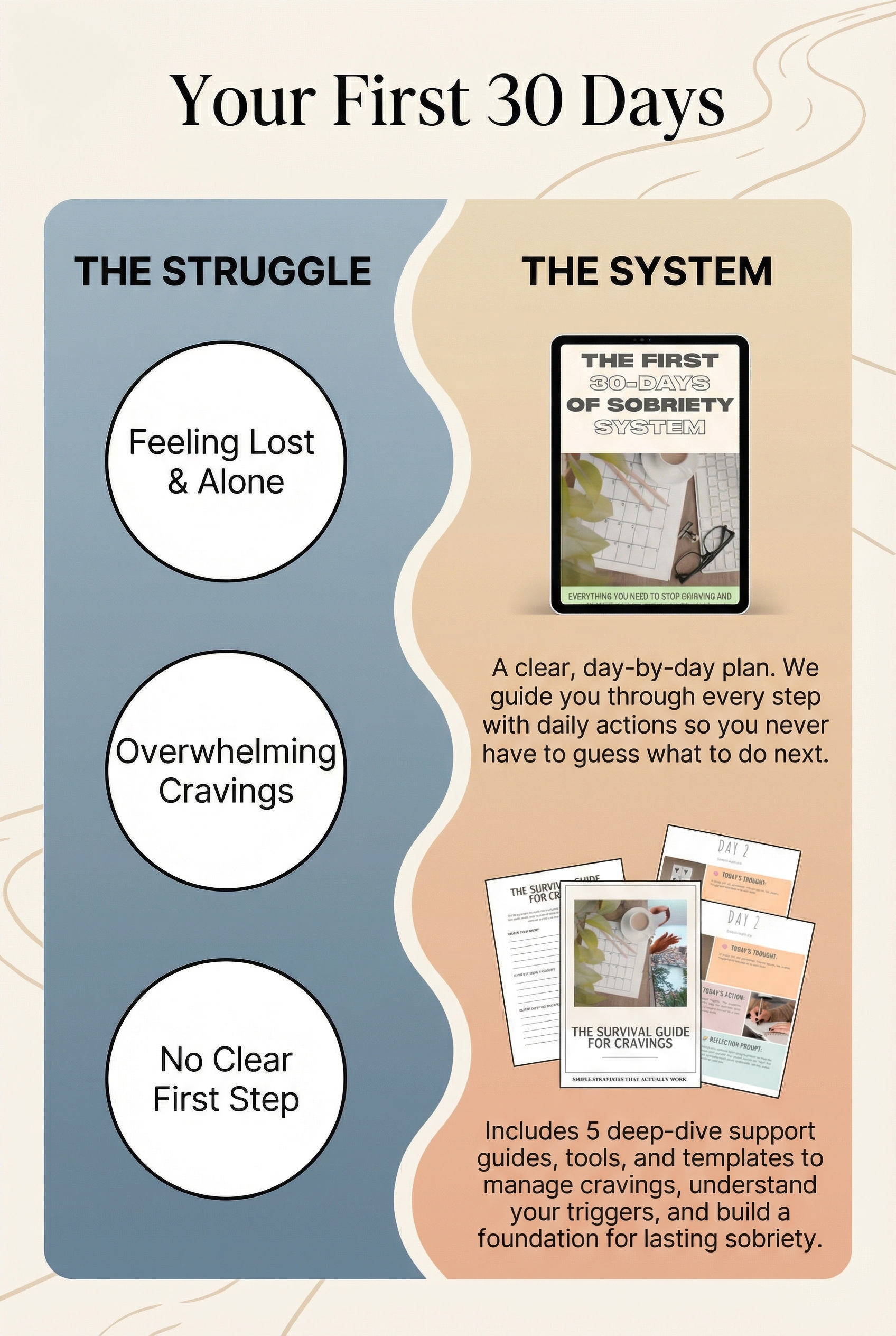
If you’re done with “Day One” over and over again, stop relying on willpower. The first 30 days are the hardest.. and that’s exactly what my 30 First Days of Sobriety System – All In One is built for. Clear daily steps. Proven tools. No guesswork. If you’re serious about quitting, follow a system that actually works.
Get it here.
Ready to Support Your Healing?
Start your journey with my free guide, Reboot Your Environment, and learn how to create a space that supports your peace, focus, and recovery.
Because the science is clear, when your environment supports your brain, staying sober feels easier.